By Tawnya Windmon
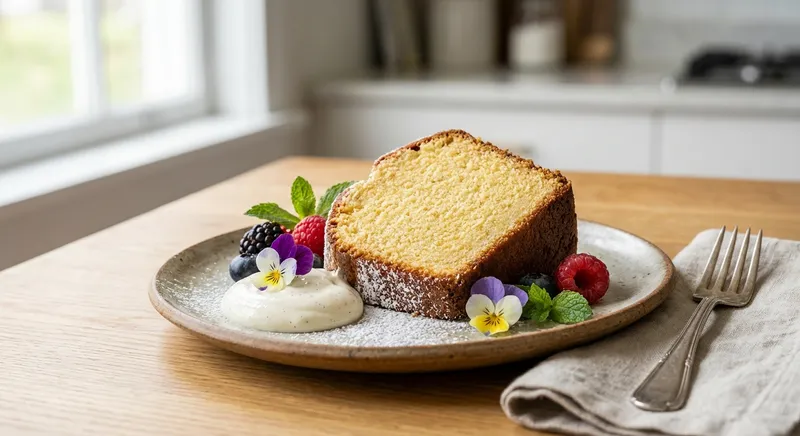
A tender, buttery vanilla pound cake with a fine, velvety crumb and a crisp, golden crust. Rich with butter and eggs and brightened by vanilla, this cake is simple yet luxurious — perfect sliced and served with fresh fruit, a dollop of cream, or a dusting of powdered sugar for a restaurant-style finish.
Prepare and preheat: Position a rack in the middle of the oven and preheat to 350°F (175°C). Grease and flour a 9x5-inch (23x13 cm) loaf pan, or line it with parchment that hangs over two sides for an easy lift. Preheating stabilizes the oven temperature and ensures even rise; lining the pan prevents sticking while the parchment makes unmolding flawless.
Measure and sift dry ingredients: Whisk the flour, baking powder, and salt together in a bowl, then sift or aerate them into a separate bowl. Sifting removes lumps and adds lightness; pre-mixing ensures the leavening is evenly distributed so the cake rises uniformly.
Cream butter and sugar for structure and air: In a large mixing bowl (or a stand mixer fitted with the paddle), beat the softened butter and granulated sugar together on medium-high until pale, creamy and noticeably lighter in color, about 4–6 minutes. This step traps air in the fat which later expands in the oven to give the cake its tender crumb and rise. Scrape down the bowl once or twice to ensure even creaming.
Incorporate eggs slowly to preserve emulsion: With the mixer on low, add the eggs one at a time, beating about 20–30 seconds after each addition, then scraping down the sides. If you add eggs too fast the batter can break (separate); slow addition keeps a stable emulsion for a smooth, tender cake. Stir in the vanilla extract with the last egg.
Alternate dry ingredients and milk: With the mixer on low, add the dry flour mixture in three additions, alternating with two additions of the milk (dry–milk–dry–milk–dry). Begin and end with the flour. Mix only until the last streak of flour disappears — overmixing develops gluten and produces a dense cake. This technique keeps the batter light while fully hydrating the flour.
Final resting and smoothing: Scrape the batter into the prepared loaf pan, and smooth the top with an offset spatula. Tap the pan gently on the counter once or twice to level the batter and release any large air pockets so the interior texture is uniform.
Bake until golden and set: Place the pan on the center rack and bake for 50–60 minutes, rotating halfway through if your oven has hot spots. The cake is done when the top is deep golden, a thin knife or skewer inserted into the center comes out with a few moist crumbs (not wet batter), and the internal temperature registers about 200–205°F (93–96°C). The thermometer gives precision; a wet center means more baking time is needed.
Cool correctly to preserve crumb: Let the cake cool in the pan on a rack for 10–15 minutes — this lets the structure set so it won’t sink when unmolded. Then use the parchment overhang (or run a thin knife around the edges) and transfer the cake to a rack to cool completely. Cooling in the pan traps steam and can make the crust soggy; finishing on the rack keeps the crust crisp.
Serve and elevate: Slice with a serrated knife using a gentle sawing motion for clean edges. Serve plain, dusted with powdered sugar, or with fresh berries and whipped cream. The cake also improves after a day as the flavors meld — wrap and store at room temperature for up to 3 days.
527
Calories
7g
Protein
75g
Carbs
26g
Fat
1g
Fiber
How did this recipe turn out? Let others know!
to rate this recipe
By Tawnya Windmon
A tender, buttery vanilla pound cake with a fine, velvety crumb and a crisp, golden crust. Rich with butter and eggs and brightened by vanilla, this cake is simple yet luxurious — perfect sliced and served with fresh fruit, a dollop of cream, or a dusting of powdered sugar for a restaurant-style finish.
Prepare and preheat: Position a rack in the middle of the oven and preheat to 350°F (175°C). Grease and flour a 9x5-inch (23x13 cm) loaf pan, or line it with parchment that hangs over two sides for an easy lift. Preheating stabilizes the oven temperature and ensures even rise; lining the pan prevents sticking while the parchment makes unmolding flawless.
Measure and sift dry ingredients: Whisk the flour, baking powder, and salt together in a bowl, then sift or aerate them into a separate bowl. Sifting removes lumps and adds lightness; pre-mixing ensures the leavening is evenly distributed so the cake rises uniformly.
Cream butter and sugar for structure and air: In a large mixing bowl (or a stand mixer fitted with the paddle), beat the softened butter and granulated sugar together on medium-high until pale, creamy and noticeably lighter in color, about 4–6 minutes. This step traps air in the fat which later expands in the oven to give the cake its tender crumb and rise. Scrape down the bowl once or twice to ensure even creaming.
Incorporate eggs slowly to preserve emulsion: With the mixer on low, add the eggs one at a time, beating about 20–30 seconds after each addition, then scraping down the sides. If you add eggs too fast the batter can break (separate); slow addition keeps a stable emulsion for a smooth, tender cake. Stir in the vanilla extract with the last egg.
Alternate dry ingredients and milk: With the mixer on low, add the dry flour mixture in three additions, alternating with two additions of the milk (dry–milk–dry–milk–dry). Begin and end with the flour. Mix only until the last streak of flour disappears — overmixing develops gluten and produces a dense cake. This technique keeps the batter light while fully hydrating the flour.
Final resting and smoothing: Scrape the batter into the prepared loaf pan, and smooth the top with an offset spatula. Tap the pan gently on the counter once or twice to level the batter and release any large air pockets so the interior texture is uniform.
Bake until golden and set: Place the pan on the center rack and bake for 50–60 minutes, rotating halfway through if your oven has hot spots. The cake is done when the top is deep golden, a thin knife or skewer inserted into the center comes out with a few moist crumbs (not wet batter), and the internal temperature registers about 200–205°F (93–96°C). The thermometer gives precision; a wet center means more baking time is needed.
Cool correctly to preserve crumb: Let the cake cool in the pan on a rack for 10–15 minutes — this lets the structure set so it won’t sink when unmolded. Then use the parchment overhang (or run a thin knife around the edges) and transfer the cake to a rack to cool completely. Cooling in the pan traps steam and can make the crust soggy; finishing on the rack keeps the crust crisp.
Serve and elevate: Slice with a serrated knife using a gentle sawing motion for clean edges. Serve plain, dusted with powdered sugar, or with fresh berries and whipped cream. The cake also improves after a day as the flavors meld — wrap and store at room temperature for up to 3 days.
527
Calories
7g
Protein
75g
Carbs
26g
Fat
1g
Fiber
Your Rating:
