By Mendy Levi
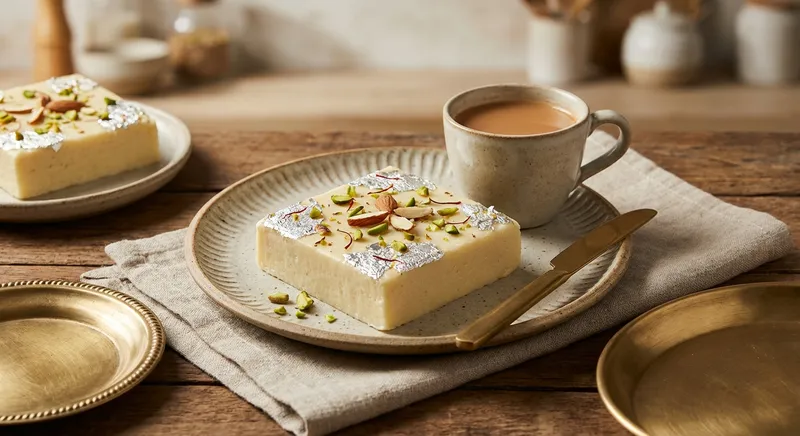
A lusciously creamy milk fudge that tastes like a caramelized, melt-in-the-mouth barfi—rich milk reduced slowly until it becomes thick, buttery and lightly spiced with cardamom. The texture is dense yet tender, with glossy edges and a delicate toffee-like flavor that comes from slow reduction and careful browning—an elevated, restaurant-quality take on a classic South Asian sweet.
Assemble equipment and ingredients. Use a wide, heavy-bottomed saucepan (3–4‑quart) to speed evaporation and distribute heat evenly — a larger surface area shortens cooking time and reduces hot spots that burn milk solids. Line an 8x8-inch square pan with parchment leaving an overhang for easy unmolding.
Warm the milk gently: pour 1 L whole milk into the saucepan and set over medium-low heat. Warm the milk until it just begins to steam and small bubbles form at the edge (do not boil). Warming reduces the shock of heat and prevents skin formation and burning while you begin the reduction.
Reduce the milk slowly: turn the heat to medium-low and maintain a gentle simmer. Stir frequently with a flat-edged wooden spoon or silicone spatula, scraping the bottom and sides. The goal is to reduce moisture and concentrate milk solids; gentle heat prevents scorching. This step takes 30–40 minutes — you’ll see the milk thicken and reduce by roughly half to two-thirds.
Add sugar in stages: once the milk is noticeably thicker and coated on the back of the spoon (and you can see traces on the pan sides when you drag the spoon), lower the heat slightly and add 350 g granulated sugar in two additions. Stir each addition until fully dissolved. Staging the sugar helps it integrate without dropping the temperature too much or graining.
Continue cooking to a jam-like stage: after the sugar dissolves, keep the mixture at a gentle simmer and stir frequently. As the water content evaporates the mixture will go from milky to glossy and then to a thicker, paste-like, slightly grainy mass. This is the key transformation — you’re caramelizing sugars and concentrating milk proteins to build structure and that toffee-like flavor. Expect another 20–30 minutes.
Butter finishing: when the mixture becomes thick and starts to pull away from the pan in clumps, reduce heat to low and add 56 g unsalted butter, stirring until fully incorporated. Butter enriches the fudge, adds silkiness and helps the final set by coating fat globules — it also mellows the sweetness.
Test doneness visually and by touch: the mass should be thick, glossy, and not watery. To test, drop a small spoonful into a bowl of cold water — it should form a soft but shape-holding pellet that can be pressed between fingers to form a squished ball (analogous to a 'soft-ball' in candy making). If it’s still loose, cook a few minutes longer and test again.
Flavor and salt balance: remove pan from heat, stir in 1/2 tsp ground cardamom, 1/8 tsp sea salt and 1 tsp vanilla extract (if using). Cardamom lends aroma and a classic South Asian flavor; a touch of salt brightens the sweetness and reveals underlying dairy flavors.
Transfer and level: immediately scrape the hot mixture into the prepared 8x8 pan and smooth the top with an offset spatula or the back of a spoon. Work quickly — the fudge will set as it cools. If you like, press a few slivered pistachios on top for color and texture (optional).
Cool and set: let the pan cool at room temperature until warm, then transfer to the refrigerator for 1 hour to fully set. Chilling firms the texture and makes clean cutting easier, but avoid over-chilling which can make the texture excessively firm — about 1 hour is usually ideal for a tender bite.
Cut and finish: lift the parchment out, trim edges and cut into 12 squares with a sharp knife. If the top has a glossy sheen, wipe the knife with a warm towel between cuts for clean edges. Store the fudge in an airtight container at room temperature for up to 3 days or refrigerated for up to 1 week.
Serving suggestion: serve at slightly below room temperature (remove from fridge 10–20 minutes before serving) so the texture is soft and creamy. Pair with strong tea or espresso to balance the sweetness.
201
Calories
3g
Protein
33g
Carbs
6g
Fat
0g
Fiber
How did this recipe turn out? Let others know!
to rate this recipe
A lusciously creamy milk fudge that tastes like a caramelized, melt-in-the-mouth barfi—rich milk reduced slowly until it becomes thick, buttery and lightly spiced with cardamom. The texture is dense yet tender, with glossy edges and a delicate toffee-like flavor that comes from slow reduction and careful browning—an elevated, restaurant-quality take on a classic South Asian sweet.
Assemble equipment and ingredients. Use a wide, heavy-bottomed saucepan (3–4‑quart) to speed evaporation and distribute heat evenly — a larger surface area shortens cooking time and reduces hot spots that burn milk solids. Line an 8x8-inch square pan with parchment leaving an overhang for easy unmolding.
Warm the milk gently: pour 1 L whole milk into the saucepan and set over medium-low heat. Warm the milk until it just begins to steam and small bubbles form at the edge (do not boil). Warming reduces the shock of heat and prevents skin formation and burning while you begin the reduction.
Reduce the milk slowly: turn the heat to medium-low and maintain a gentle simmer. Stir frequently with a flat-edged wooden spoon or silicone spatula, scraping the bottom and sides. The goal is to reduce moisture and concentrate milk solids; gentle heat prevents scorching. This step takes 30–40 minutes — you’ll see the milk thicken and reduce by roughly half to two-thirds.
Add sugar in stages: once the milk is noticeably thicker and coated on the back of the spoon (and you can see traces on the pan sides when you drag the spoon), lower the heat slightly and add 350 g granulated sugar in two additions. Stir each addition until fully dissolved. Staging the sugar helps it integrate without dropping the temperature too much or graining.
Continue cooking to a jam-like stage: after the sugar dissolves, keep the mixture at a gentle simmer and stir frequently. As the water content evaporates the mixture will go from milky to glossy and then to a thicker, paste-like, slightly grainy mass. This is the key transformation — you’re caramelizing sugars and concentrating milk proteins to build structure and that toffee-like flavor. Expect another 20–30 minutes.
Butter finishing: when the mixture becomes thick and starts to pull away from the pan in clumps, reduce heat to low and add 56 g unsalted butter, stirring until fully incorporated. Butter enriches the fudge, adds silkiness and helps the final set by coating fat globules — it also mellows the sweetness.
Test doneness visually and by touch: the mass should be thick, glossy, and not watery. To test, drop a small spoonful into a bowl of cold water — it should form a soft but shape-holding pellet that can be pressed between fingers to form a squished ball (analogous to a 'soft-ball' in candy making). If it’s still loose, cook a few minutes longer and test again.
Flavor and salt balance: remove pan from heat, stir in 1/2 tsp ground cardamom, 1/8 tsp sea salt and 1 tsp vanilla extract (if using). Cardamom lends aroma and a classic South Asian flavor; a touch of salt brightens the sweetness and reveals underlying dairy flavors.
Transfer and level: immediately scrape the hot mixture into the prepared 8x8 pan and smooth the top with an offset spatula or the back of a spoon. Work quickly — the fudge will set as it cools. If you like, press a few slivered pistachios on top for color and texture (optional).
Cool and set: let the pan cool at room temperature until warm, then transfer to the refrigerator for 1 hour to fully set. Chilling firms the texture and makes clean cutting easier, but avoid over-chilling which can make the texture excessively firm — about 1 hour is usually ideal for a tender bite.
Cut and finish: lift the parchment out, trim edges and cut into 12 squares with a sharp knife. If the top has a glossy sheen, wipe the knife with a warm towel between cuts for clean edges. Store the fudge in an airtight container at room temperature for up to 3 days or refrigerated for up to 1 week.
Serving suggestion: serve at slightly below room temperature (remove from fridge 10–20 minutes before serving) so the texture is soft and creamy. Pair with strong tea or espresso to balance the sweetness.
201
Calories
3g
Protein
33g
Carbs
6g
Fat
0g
Fiber
Your Rating:
