By emensah m
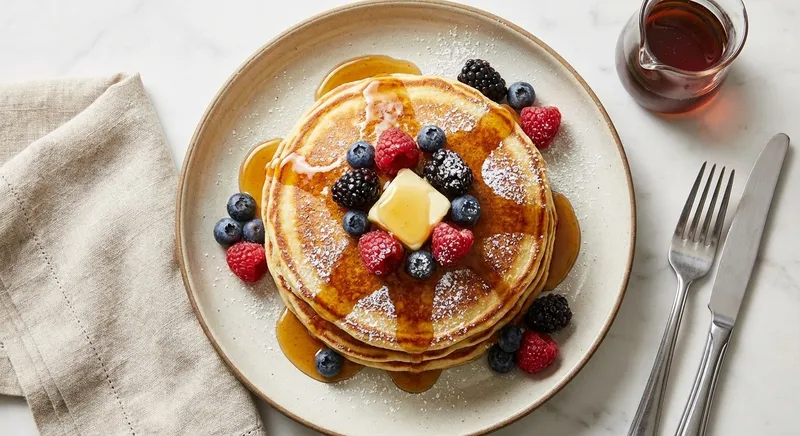
Thick, tender buttermilk pancakes with a golden, lacy edge and a pillowy interior — the kind you find at neighborhood brunch spots. Brightened with a touch of vanilla and a hint of lemon-soured milk (homemade buttermilk), these pancakes are lightly sweet, richly flavored from butter, and flexible enough to dress up with fruit, compotes or browned butter syrup.
Make quick buttermilk: pour the 420 ml whole milk into a measuring cup and stir in the 30 ml (2 tbsp) lemon juice. Let sit for 5–8 minutes until slightly thickened and opaque. WHY: The acid in lemon curdles the milk proteins slightly, mimicking buttermilk’s tang and acidity—this reacts with baking soda to give tall, tender pancakes.
Sift and combine the dry ingredients: Whisk the 240 g (2 cups) flour, 25 g sugar, 8 g baking powder, 2.5 g baking soda, and 3 g salt in a large bowl. WHY: Sifting/whisking distributes leavening evenly and aerates the flour so pancakes rise uniformly and stay light rather than gummy.
Whisk the wet ingredients: In a separate bowl, beat the 2 large eggs lightly, then whisk in the soured milk, 56 g melted butter (warm, not hot), and 5 ml vanilla. WHY: Mixing wet ingredients separately makes it easier to combine them with the dry without overworking the batter; melted butter adds richness and helps form a fine crumb.
Combine wet and dry: Make a well in the center of the dry ingredients and pour in the wet mixture. Gently fold with a spatula until the batter just comes together—some small lumps are okay. WHY: Over-mixing develops gluten and makes pancakes tough; a few lumps will hydrate out during resting and cooking, producing a tender pancake.
Rest the batter 5–10 minutes while you preheat the pan. WHY: Resting lets the flour hydrate and the leavening begin to work, giving a lighter texture and more predictable bubbles when cooking.
Preheat and test the pan: Heat a heavy skillet or nonstick griddle over medium heat for 3–5 minutes. Brush lightly with oil or melt a small pat of butter. Drop a 1-tablespoon test spoon of batter—if it sizzles and the edges set within 20–30 seconds and bubbles appear on the surface within a minute, the pan is ready. WHY: A properly preheated surface yields an even golden crust; too-hot means burnt exterior and raw interior, too-cool yields pale, dense pancakes.
Cook the pancakes: For each pancake, pour 60–75 ml (about 1/4 cup) batter onto the hot surface, leaving space between pancakes. Cook until bubbles form across the surface and many bubbles begin to pop (about 2–3 minutes), then flip and cook 1–2 minutes more until deep golden and set. WHY: Waiting for the bubbles to form and pop ensures the center is cooked; flipping too soon prevents proper lift and causes deflation.
Hold and finish: Transfer finished pancakes to a warm oven (around 90–100°C / 200°F) on a wire rack set over a baking sheet while you finish the batch. WHY: Holding on a rack keeps bottoms from steaming and softening and lets you serve a full batch piping hot.
Serve suggestions: Stack the pancakes, dot with butter, drizzle with maple syrup or browned-butter syrup, and finish with fresh berries, sliced banana, toasted nuts, or a spoonful of yogurt. WHY: Contrasting textures and acid/cream elements (like yogurt or lemon zest) brighten the rich pancakes and make the plate feel restaurant-quality.
480
Calories
13g
Protein
58g
Carbs
21g
Fat
2g
Fiber
How did this recipe turn out? Let others know!
to rate this recipe
By emensah m
Thick, tender buttermilk pancakes with a golden, lacy edge and a pillowy interior — the kind you find at neighborhood brunch spots. Brightened with a touch of vanilla and a hint of lemon-soured milk (homemade buttermilk), these pancakes are lightly sweet, richly flavored from butter, and flexible enough to dress up with fruit, compotes or browned butter syrup.
Make quick buttermilk: pour the 420 ml whole milk into a measuring cup and stir in the 30 ml (2 tbsp) lemon juice. Let sit for 5–8 minutes until slightly thickened and opaque. WHY: The acid in lemon curdles the milk proteins slightly, mimicking buttermilk’s tang and acidity—this reacts with baking soda to give tall, tender pancakes.
Sift and combine the dry ingredients: Whisk the 240 g (2 cups) flour, 25 g sugar, 8 g baking powder, 2.5 g baking soda, and 3 g salt in a large bowl. WHY: Sifting/whisking distributes leavening evenly and aerates the flour so pancakes rise uniformly and stay light rather than gummy.
Whisk the wet ingredients: In a separate bowl, beat the 2 large eggs lightly, then whisk in the soured milk, 56 g melted butter (warm, not hot), and 5 ml vanilla. WHY: Mixing wet ingredients separately makes it easier to combine them with the dry without overworking the batter; melted butter adds richness and helps form a fine crumb.
Combine wet and dry: Make a well in the center of the dry ingredients and pour in the wet mixture. Gently fold with a spatula until the batter just comes together—some small lumps are okay. WHY: Over-mixing develops gluten and makes pancakes tough; a few lumps will hydrate out during resting and cooking, producing a tender pancake.
Rest the batter 5–10 minutes while you preheat the pan. WHY: Resting lets the flour hydrate and the leavening begin to work, giving a lighter texture and more predictable bubbles when cooking.
Preheat and test the pan: Heat a heavy skillet or nonstick griddle over medium heat for 3–5 minutes. Brush lightly with oil or melt a small pat of butter. Drop a 1-tablespoon test spoon of batter—if it sizzles and the edges set within 20–30 seconds and bubbles appear on the surface within a minute, the pan is ready. WHY: A properly preheated surface yields an even golden crust; too-hot means burnt exterior and raw interior, too-cool yields pale, dense pancakes.
Cook the pancakes: For each pancake, pour 60–75 ml (about 1/4 cup) batter onto the hot surface, leaving space between pancakes. Cook until bubbles form across the surface and many bubbles begin to pop (about 2–3 minutes), then flip and cook 1–2 minutes more until deep golden and set. WHY: Waiting for the bubbles to form and pop ensures the center is cooked; flipping too soon prevents proper lift and causes deflation.
Hold and finish: Transfer finished pancakes to a warm oven (around 90–100°C / 200°F) on a wire rack set over a baking sheet while you finish the batch. WHY: Holding on a rack keeps bottoms from steaming and softening and lets you serve a full batch piping hot.
Serve suggestions: Stack the pancakes, dot with butter, drizzle with maple syrup or browned-butter syrup, and finish with fresh berries, sliced banana, toasted nuts, or a spoonful of yogurt. WHY: Contrasting textures and acid/cream elements (like yogurt or lemon zest) brighten the rich pancakes and make the plate feel restaurant-quality.
480
Calories
13g
Protein
58g
Carbs
21g
Fat
2g
Fiber
Your Rating:
