By Andrew Acosta
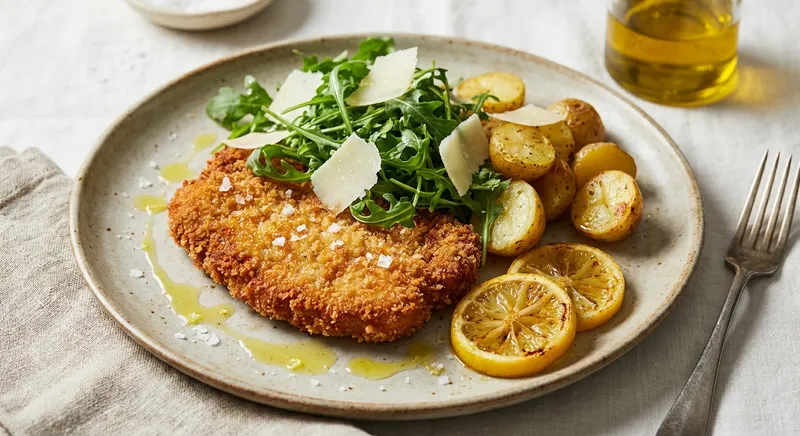
A restaurant-style Pork Milanese: a paper-thin pork loin cutlet, pounded, lightly breaded and pan-seared to an ultra-crisp golden crust, served on a bed of peppery lemon-dressed arugula with shaved Parmesan and warm lemon-roasted new potatoes. Bright lemon, nutty Parmesan and rosemary-roasted potatoes balance the savory crunch — elegant enough for guests, straightforward enough for a weeknight.
Bring the pork and the arugula out of the fridge for 10 minutes so they aren’t ice-cold — room-temperature meat browns more evenly. Pat the 140 g pork loin dry with paper towels (moisture prevents good crust formation). Season both sides lightly with salt and pepper.
Set up a simple breading station: on a plate place the 10 g flour; in a shallow bowl beat the large egg; on another plate spread the 20 g panko breadcrumbs. Dry flouring first helps the egg adhere, and the egg seals the panko to the meat for a consistent, clingy crust.
Lightly dust the pork on both sides with flour, shaking off excess. Dip into the beaten egg, letting excess drip off, then press both sides into the panko so the crumbs adhere in an even, thin layer. A thin, tight coating crisps faster and won’t taste bready — that’s why we use modest amounts of flour and panko.
Heat a heavy skillet (cast-iron or stainless steel) over medium-high heat for 2–3 minutes; a properly preheated pan helps the oil shimmer and prevents the cutlet from sticking. Add 1 tbsp olive oil and swirl to coat. Heat the oil until it’s shimmering but not smoking (about 180–190°C/355–375°F). Olive oil gives a fruity note and a good sear at this temperature.
Carefully lay the panko-coated pork into the hot oil away from you — this prevents splatter. Don’t crowd the pan; if it’s a snug fit, cook in a single layer. Sear without moving for 2–3 minutes to develop an even golden-brown crust; the crust forms best when left undisturbed. Flip and cook the other side 2–3 minutes more. Because the pork is thin and pounded, it cooks quickly — you’re aiming for just-cooked through (internal about 63°C / 145°F). Overcooking will dry the lean loin.
If the crust is browning too fast before the pork is cooked, lower the heat slightly and finish in a 180°C (350°F) oven for 3–4 minutes; this is a gentle way to ensure doneness without burning the crumbs. Transfer cooked cutlet to a wire rack or paper towel-lined plate to rest 3 minutes — resting lets juices redistribute and the crust remain crisp (direct contact with a plate steams the underside, which we avoid).
While the pork rests, reheat the 80 g roasted new potatoes. If they’re already warm, hold them; if chilled, toss them in a hot skillet with 1 tsp olive oil over medium heat for 3–4 minutes to refresh their roast flavor and re-crisp edges. Heating with a little oil revitalizes the roast surface and helps the rosemary and lemon aroma bloom.
Toss the 60 g arugula with 1 tsp olive oil and 1/2 tsp fresh lemon juice, and season with a pinch of salt and pepper. Dress the greens just before plating so they stay bright and peppery — arugula wilts quickly under heat or heavy dressing.
To plate: mound the dressed arugula slightly off-center, place the warm roasted potatoes beside it, and lay the crispy pork Milanese on top of the arugula or leaned against it so the crust stays visible. Scatter 10 g shaved Parmesan over the arugula and pork — the Parmesan’s nuttiness and slight saltiness ties the components together.
Finish with a squeeze of the lemon wedge over the pork and potatoes. The bright acid cuts through the fat, lifting flavors and sharpening the crust’s savoriness. Serve immediately so the cutlet is still warm and crisp.
697
Calories
50g
Protein
39g
Carbs
37g
Fat
4g
Fiber
How did this recipe turn out? Let others know!
to rate this recipe
By Andrew Acosta
A restaurant-style Pork Milanese: a paper-thin pork loin cutlet, pounded, lightly breaded and pan-seared to an ultra-crisp golden crust, served on a bed of peppery lemon-dressed arugula with shaved Parmesan and warm lemon-roasted new potatoes. Bright lemon, nutty Parmesan and rosemary-roasted potatoes balance the savory crunch — elegant enough for guests, straightforward enough for a weeknight.
Bring the pork and the arugula out of the fridge for 10 minutes so they aren’t ice-cold — room-temperature meat browns more evenly. Pat the 140 g pork loin dry with paper towels (moisture prevents good crust formation). Season both sides lightly with salt and pepper.
Set up a simple breading station: on a plate place the 10 g flour; in a shallow bowl beat the large egg; on another plate spread the 20 g panko breadcrumbs. Dry flouring first helps the egg adhere, and the egg seals the panko to the meat for a consistent, clingy crust.
Lightly dust the pork on both sides with flour, shaking off excess. Dip into the beaten egg, letting excess drip off, then press both sides into the panko so the crumbs adhere in an even, thin layer. A thin, tight coating crisps faster and won’t taste bready — that’s why we use modest amounts of flour and panko.
Heat a heavy skillet (cast-iron or stainless steel) over medium-high heat for 2–3 minutes; a properly preheated pan helps the oil shimmer and prevents the cutlet from sticking. Add 1 tbsp olive oil and swirl to coat. Heat the oil until it’s shimmering but not smoking (about 180–190°C/355–375°F). Olive oil gives a fruity note and a good sear at this temperature.
Carefully lay the panko-coated pork into the hot oil away from you — this prevents splatter. Don’t crowd the pan; if it’s a snug fit, cook in a single layer. Sear without moving for 2–3 minutes to develop an even golden-brown crust; the crust forms best when left undisturbed. Flip and cook the other side 2–3 minutes more. Because the pork is thin and pounded, it cooks quickly — you’re aiming for just-cooked through (internal about 63°C / 145°F). Overcooking will dry the lean loin.
If the crust is browning too fast before the pork is cooked, lower the heat slightly and finish in a 180°C (350°F) oven for 3–4 minutes; this is a gentle way to ensure doneness without burning the crumbs. Transfer cooked cutlet to a wire rack or paper towel-lined plate to rest 3 minutes — resting lets juices redistribute and the crust remain crisp (direct contact with a plate steams the underside, which we avoid).
While the pork rests, reheat the 80 g roasted new potatoes. If they’re already warm, hold them; if chilled, toss them in a hot skillet with 1 tsp olive oil over medium heat for 3–4 minutes to refresh their roast flavor and re-crisp edges. Heating with a little oil revitalizes the roast surface and helps the rosemary and lemon aroma bloom.
Toss the 60 g arugula with 1 tsp olive oil and 1/2 tsp fresh lemon juice, and season with a pinch of salt and pepper. Dress the greens just before plating so they stay bright and peppery — arugula wilts quickly under heat or heavy dressing.
To plate: mound the dressed arugula slightly off-center, place the warm roasted potatoes beside it, and lay the crispy pork Milanese on top of the arugula or leaned against it so the crust stays visible. Scatter 10 g shaved Parmesan over the arugula and pork — the Parmesan’s nuttiness and slight saltiness ties the components together.
Finish with a squeeze of the lemon wedge over the pork and potatoes. The bright acid cuts through the fat, lifting flavors and sharpening the crust’s savoriness. Serve immediately so the cutlet is still warm and crisp.
697
Calories
50g
Protein
39g
Carbs
37g
Fat
4g
Fiber
Your Rating:
