By emensah m
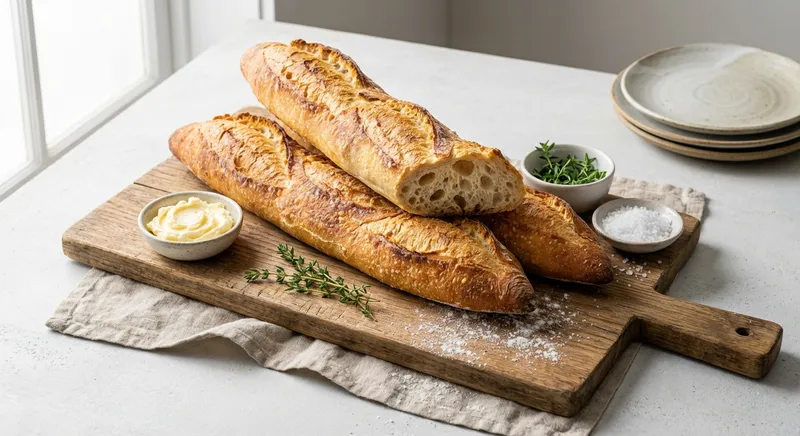
Crisp, blistered crust giving way to a light, open crumb — these classic French baguettes use a small poolish preferment and a long-ish fermentation for deep, wheaty flavor and excellent oven spring. The result is a rustic, restaurant-quality loaf with crunchy exterior, glossy browned slashes, and an airy interior perfect for sandwiches or simply slathered with butter.
Make the poolish (preferment): In a medium bowl whisk together 100 g bread flour, 100 g water (room temperature) and a tiny pinch of instant yeast (about 1/8 tsp, ~0.4 g). Cover tightly and leave at room temperature for 10–12 hours (or until bubbly and doubled). Why: Poolish develops complex, slightly sweet and tangy flavors and improves oven spring while allowing you to use less yeast in the final dough.
Measure and autolyse: In a large mixing bowl combine the remaining 400 g bread flour and 250 g water. Mix briefly until no dry streaks remain, then let sit, covered, for 20–30 minutes. Why: Autolyse hydrates the flour and begins gluten formation, which reduces kneading time and helps create an open crumb.
Add poolish, yeast, and salt: After autolyse, add the bubbly poolish, the remaining instant yeast (approx. 1 tsp / 3 g), and 10 g salt. Mix until the ingredients come together into a shaggy dough. Why: Adding the yeast separately lets the preferment's flavors shine while ensuring there is enough yeast for predictable bulk fermentation.
Develop gluten with stretch-and-folds: Transfer the dough to a lightly oiled bowl or keep in the mixing bowl. Every 30 minutes for 2 hours perform a series of 4 stretch-and-folds: reach under the dough, stretch a portion up and fold it over the center, rotate the bowl and repeat until you've circled the dough. Why: Gentle stretch-and-folds strengthen the gluten network with less oxidation than heavy kneading and preserve gas for a better crumb.
Bulk fermentation: After the last fold, cover and let the dough rest at room temperature until it has increased about 30–50% in volume (about 1–1.5 hours depending on room temperature). Why: During bulk fermentation the dough gains flavor and structure; stop the bulk when the dough has grown and shows bubbles but still passes the poke test (a gentle poke should slowly fill back in).
Pre-shape and bench rest: Turn the dough gently onto a lightly floured surface. Divide into two equal pieces (about 475 g each). Pre-shape each piece into a rough cylinder by folding edges toward the center, seam-side down. Let rest uncovered for 15–20 minutes to relax the gluten. Why: Pre-shaping builds initial surface tension and the bench rest relaxes the dough so final shaping is easier and tighter.
Final shaping into baguettes: To shape, flatten a pre-shaped piece into a rectangle, fold the top third down over the center, then the bottom third up, press to seal, then roll the dough away from you with both hands to lengthen into a 14–16" (35–40 cm) baguette, sealing the seam by pinching. Taper the ends slightly by applying more pressure as you roll them. Why: Proper shaping creates a smooth skin that traps gas and encourages a strong oven spring and classic baguette silhouette.
Final proof: Place shaped baguettes seam-side down on a couche, floured linen, or a baking tray dusted with semolina; fold the couche between loaves to support the sides. Cover loosely with a towel and proof for 45–60 minutes at room temperature until puffy but not overproofed (gently press — it should spring back slowly). Why: The final proof sets the loaf’s shape and affects crumb texture; underproofed dough won't expand much in the oven and overproofed dough will collapse.
Preheat the oven and prepare steam: Place a baking stone or heavy baking sheet on the middle rack and a metal tray on the bottom rack. Preheat oven to 475°F (245°C) for at least 45 minutes so the stone is thoroughly hot. Just before baking, pour 1 cup of hot water into the bottom tray to create steam, or use an oven-safe spray bottle to mist. Why: A very hot baking surface combined with steam during the first 7–10 minutes allows the crust to expand (oven spring) and then set with a thin, glossy, blistered crust.
Score and bake: Turn the baguettes onto a peel or an inverted tray dusted with semolina. Using a very sharp lame or razor held at a 30–40° angle, make 5–6 quick diagonal slashes (about 1/4"–1/3" deep) down each loaf. Slide onto the hot stone, add steam, and bake at 475°F (245°C) for 12 minutes with steam, then remove the bottom tray (or open vent) to release steam and lower temperature to 450°F (230°C). Bake another 8–12 minutes until deep golden brown and hollow-sounding when tapped. Why: Scoring controls where the loaf expands and creates the signature ear; starting with steam maximizes oven spring and produces that crisp, thin crust.
Cool before slicing: Transfer to a wire rack and let cool at least 45 minutes before slicing. Why: Cooling lets the crumb finish setting; slicing too soon yields a gummy interior.
466
Calories
15g
Protein
97g
Carbs
1g
Fat
4g
Fiber
How did this recipe turn out? Let others know!
to rate this recipe
By emensah m
Crisp, blistered crust giving way to a light, open crumb — these classic French baguettes use a small poolish preferment and a long-ish fermentation for deep, wheaty flavor and excellent oven spring. The result is a rustic, restaurant-quality loaf with crunchy exterior, glossy browned slashes, and an airy interior perfect for sandwiches or simply slathered with butter.
Make the poolish (preferment): In a medium bowl whisk together 100 g bread flour, 100 g water (room temperature) and a tiny pinch of instant yeast (about 1/8 tsp, ~0.4 g). Cover tightly and leave at room temperature for 10–12 hours (or until bubbly and doubled). Why: Poolish develops complex, slightly sweet and tangy flavors and improves oven spring while allowing you to use less yeast in the final dough.
Measure and autolyse: In a large mixing bowl combine the remaining 400 g bread flour and 250 g water. Mix briefly until no dry streaks remain, then let sit, covered, for 20–30 minutes. Why: Autolyse hydrates the flour and begins gluten formation, which reduces kneading time and helps create an open crumb.
Add poolish, yeast, and salt: After autolyse, add the bubbly poolish, the remaining instant yeast (approx. 1 tsp / 3 g), and 10 g salt. Mix until the ingredients come together into a shaggy dough. Why: Adding the yeast separately lets the preferment's flavors shine while ensuring there is enough yeast for predictable bulk fermentation.
Develop gluten with stretch-and-folds: Transfer the dough to a lightly oiled bowl or keep in the mixing bowl. Every 30 minutes for 2 hours perform a series of 4 stretch-and-folds: reach under the dough, stretch a portion up and fold it over the center, rotate the bowl and repeat until you've circled the dough. Why: Gentle stretch-and-folds strengthen the gluten network with less oxidation than heavy kneading and preserve gas for a better crumb.
Bulk fermentation: After the last fold, cover and let the dough rest at room temperature until it has increased about 30–50% in volume (about 1–1.5 hours depending on room temperature). Why: During bulk fermentation the dough gains flavor and structure; stop the bulk when the dough has grown and shows bubbles but still passes the poke test (a gentle poke should slowly fill back in).
Pre-shape and bench rest: Turn the dough gently onto a lightly floured surface. Divide into two equal pieces (about 475 g each). Pre-shape each piece into a rough cylinder by folding edges toward the center, seam-side down. Let rest uncovered for 15–20 minutes to relax the gluten. Why: Pre-shaping builds initial surface tension and the bench rest relaxes the dough so final shaping is easier and tighter.
Final shaping into baguettes: To shape, flatten a pre-shaped piece into a rectangle, fold the top third down over the center, then the bottom third up, press to seal, then roll the dough away from you with both hands to lengthen into a 14–16" (35–40 cm) baguette, sealing the seam by pinching. Taper the ends slightly by applying more pressure as you roll them. Why: Proper shaping creates a smooth skin that traps gas and encourages a strong oven spring and classic baguette silhouette.
Final proof: Place shaped baguettes seam-side down on a couche, floured linen, or a baking tray dusted with semolina; fold the couche between loaves to support the sides. Cover loosely with a towel and proof for 45–60 minutes at room temperature until puffy but not overproofed (gently press — it should spring back slowly). Why: The final proof sets the loaf’s shape and affects crumb texture; underproofed dough won't expand much in the oven and overproofed dough will collapse.
Preheat the oven and prepare steam: Place a baking stone or heavy baking sheet on the middle rack and a metal tray on the bottom rack. Preheat oven to 475°F (245°C) for at least 45 minutes so the stone is thoroughly hot. Just before baking, pour 1 cup of hot water into the bottom tray to create steam, or use an oven-safe spray bottle to mist. Why: A very hot baking surface combined with steam during the first 7–10 minutes allows the crust to expand (oven spring) and then set with a thin, glossy, blistered crust.
Score and bake: Turn the baguettes onto a peel or an inverted tray dusted with semolina. Using a very sharp lame or razor held at a 30–40° angle, make 5–6 quick diagonal slashes (about 1/4"–1/3" deep) down each loaf. Slide onto the hot stone, add steam, and bake at 475°F (245°C) for 12 minutes with steam, then remove the bottom tray (or open vent) to release steam and lower temperature to 450°F (230°C). Bake another 8–12 minutes until deep golden brown and hollow-sounding when tapped. Why: Scoring controls where the loaf expands and creates the signature ear; starting with steam maximizes oven spring and produces that crisp, thin crust.
Cool before slicing: Transfer to a wire rack and let cool at least 45 minutes before slicing. Why: Cooling lets the crumb finish setting; slicing too soon yields a gummy interior.
466
Calories
15g
Protein
97g
Carbs
1g
Fat
4g
Fiber
Your Rating:
