By abbey f
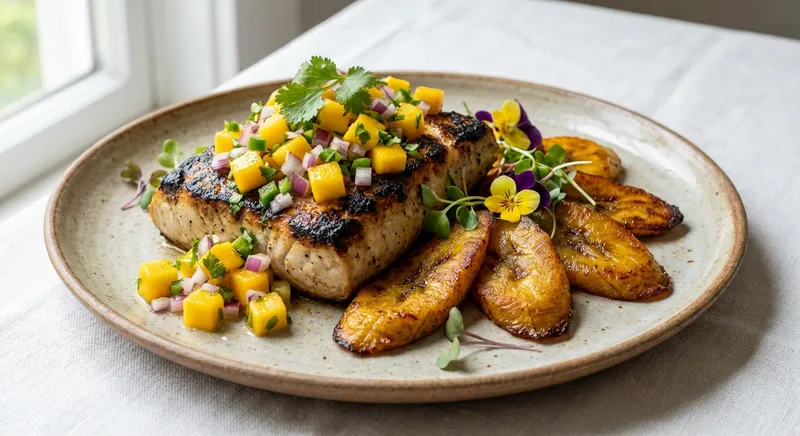
A bright, Caribbean-inspired plate that balances firm, meaty grilled mahi-mahi with a sweet-tart mango salsa and caramelized roasted plantains. The fish develops a golden char for savory depth while the mango salsa adds juicy sweetness, acid and crunch — finished with toasted plantains for a buttery-sweet contrast.
Preheat and prep: Preheat your oven to 220°C (425°F) for the plantains and set a heavy skillet or grill pan over medium-high heat to preheat for the mahi-mahi. Preheating the oven and pan ensures quick, even caramelization on the plantains and a strong initial sear on the fish — both important for texture and flavor.
Make the mango salsa while the equipment heats: finely dice the mango into roughly 5 mm pieces (about 150 g), the red bell pepper (about 1/4 pepper, 37.5 g) into the same size, and very finely dice the red onion (about 1/8 onion, 13.75 g). Chop the cilantro (1 tbsp). Place these in a bowl and add the zest and juice of 1 lime, a pinch (about 1/8 tsp) of salt, 1/8 tsp freshly ground black pepper and a drizzle (about 1/2 tbsp) of the olive oil. Stir gently. Rationale: equal-size dice creates a pleasant, consistent bite; lime juice brightens and balances the mango’s sweetness; a little oil helps flavors meld and gives the salsa body.
Taste and adjust the salsa: taste for balance — it should be lively with sweet mango, bright acid and a touch of salt. If the salsa tastes flat, add a squeeze more lime; if too tart, a pinch of sugar or a tiny drizzle of additional olive oil will round it out. Allow the salsa to sit at room temperature while you prepare the plantains and fish so the flavors can marry.
Prepare the plantains: peel the small plantain and slice on a 45° bias into 1 cm (about 3/8 inch) thick slices. Toss the slices with 1 tbsp of the olive oil and a pinch (about 1/4 tsp) of salt so they are evenly coated. Why: slicing on the bias increases surface area for browning and the oil promotes caramelization and prevents sticking.
Roast the plantains: arrange the oiled plantain slices in a single layer on a rimmed baking sheet lined with parchment or a light film of oil. Roast at 220°C (425°F) for 16–18 minutes, flipping once halfway through until edges are golden and sugars have caramelized. Why: high dry heat encourages the natural sugars in ripe plantain to caramelize, creating a sweet, slightly crispy exterior with a tender interior.
Season the mahi-mahi: pat the 200 g fillet dry with paper towels (this helps get a good sear), then season both sides with about 1/2 tsp kosher salt and 1/8 tsp freshly ground black pepper. Brush lightly with the remaining 1/2 tbsp olive oil. Why: dryness and oil promote browning through the Maillard reaction; salt seasons the flesh and helps create a thin seasoned crust.
Sear or grill the fish: when your pan is smoking lightly (hot — about medium-high), add a small drop of oil and place the fish in the pan away from you. Cook without moving for 3–4 minutes until the underside is golden and a crust has formed. Flip with a spatula and cook the second side 2–3 minutes, or until the fish is opaque through most of its thickness and flakes easily with a fork. Why: a quick, hot sear locks in moisture and creates a caramelized crust that contrasts the delicate interior; overcooking will dry the fish, so cook just until opaque.
Rest the fish briefly: transfer the mahi-mahi to a plate and let it rest for 2 minutes. Resting lets the cooking finish gently and the juices redistribute, keeping the fillet moist.
Plate: arrange the roasted plantain slices on the plate; place the mahi-mahi fillet on top or to the side. Spoon 3–4 tablespoons of the mango salsa over the fish (or serve the salsa on the side). Finish with a small sprinkle of chopped cilantro and an extra squeeze of lime if desired. Why: hot fish meets cool salsa for a contrast of temperature and texture — the fruit salsa brightens the rich, caramelized flavors.
Finish and serve: serve immediately while the fish is warm and the plantains are still slightly crisp at the edges. Leftover salsa can be refrigerated (covered) up to 24 hours and used on salads or grilled meats.
697
Calories
50g
Protein
62g
Carbs
27g
Fat
6g
Fiber
How did this recipe turn out? Let others know!
to rate this recipe
By abbey f
A bright, Caribbean-inspired plate that balances firm, meaty grilled mahi-mahi with a sweet-tart mango salsa and caramelized roasted plantains. The fish develops a golden char for savory depth while the mango salsa adds juicy sweetness, acid and crunch — finished with toasted plantains for a buttery-sweet contrast.
Preheat and prep: Preheat your oven to 220°C (425°F) for the plantains and set a heavy skillet or grill pan over medium-high heat to preheat for the mahi-mahi. Preheating the oven and pan ensures quick, even caramelization on the plantains and a strong initial sear on the fish — both important for texture and flavor.
Make the mango salsa while the equipment heats: finely dice the mango into roughly 5 mm pieces (about 150 g), the red bell pepper (about 1/4 pepper, 37.5 g) into the same size, and very finely dice the red onion (about 1/8 onion, 13.75 g). Chop the cilantro (1 tbsp). Place these in a bowl and add the zest and juice of 1 lime, a pinch (about 1/8 tsp) of salt, 1/8 tsp freshly ground black pepper and a drizzle (about 1/2 tbsp) of the olive oil. Stir gently. Rationale: equal-size dice creates a pleasant, consistent bite; lime juice brightens and balances the mango’s sweetness; a little oil helps flavors meld and gives the salsa body.
Taste and adjust the salsa: taste for balance — it should be lively with sweet mango, bright acid and a touch of salt. If the salsa tastes flat, add a squeeze more lime; if too tart, a pinch of sugar or a tiny drizzle of additional olive oil will round it out. Allow the salsa to sit at room temperature while you prepare the plantains and fish so the flavors can marry.
Prepare the plantains: peel the small plantain and slice on a 45° bias into 1 cm (about 3/8 inch) thick slices. Toss the slices with 1 tbsp of the olive oil and a pinch (about 1/4 tsp) of salt so they are evenly coated. Why: slicing on the bias increases surface area for browning and the oil promotes caramelization and prevents sticking.
Roast the plantains: arrange the oiled plantain slices in a single layer on a rimmed baking sheet lined with parchment or a light film of oil. Roast at 220°C (425°F) for 16–18 minutes, flipping once halfway through until edges are golden and sugars have caramelized. Why: high dry heat encourages the natural sugars in ripe plantain to caramelize, creating a sweet, slightly crispy exterior with a tender interior.
Season the mahi-mahi: pat the 200 g fillet dry with paper towels (this helps get a good sear), then season both sides with about 1/2 tsp kosher salt and 1/8 tsp freshly ground black pepper. Brush lightly with the remaining 1/2 tbsp olive oil. Why: dryness and oil promote browning through the Maillard reaction; salt seasons the flesh and helps create a thin seasoned crust.
Sear or grill the fish: when your pan is smoking lightly (hot — about medium-high), add a small drop of oil and place the fish in the pan away from you. Cook without moving for 3–4 minutes until the underside is golden and a crust has formed. Flip with a spatula and cook the second side 2–3 minutes, or until the fish is opaque through most of its thickness and flakes easily with a fork. Why: a quick, hot sear locks in moisture and creates a caramelized crust that contrasts the delicate interior; overcooking will dry the fish, so cook just until opaque.
Rest the fish briefly: transfer the mahi-mahi to a plate and let it rest for 2 minutes. Resting lets the cooking finish gently and the juices redistribute, keeping the fillet moist.
Plate: arrange the roasted plantain slices on the plate; place the mahi-mahi fillet on top or to the side. Spoon 3–4 tablespoons of the mango salsa over the fish (or serve the salsa on the side). Finish with a small sprinkle of chopped cilantro and an extra squeeze of lime if desired. Why: hot fish meets cool salsa for a contrast of temperature and texture — the fruit salsa brightens the rich, caramelized flavors.
Finish and serve: serve immediately while the fish is warm and the plantains are still slightly crisp at the edges. Leftover salsa can be refrigerated (covered) up to 24 hours and used on salads or grilled meats.
697
Calories
50g
Protein
62g
Carbs
27g
Fat
6g
Fiber
Your Rating:
